
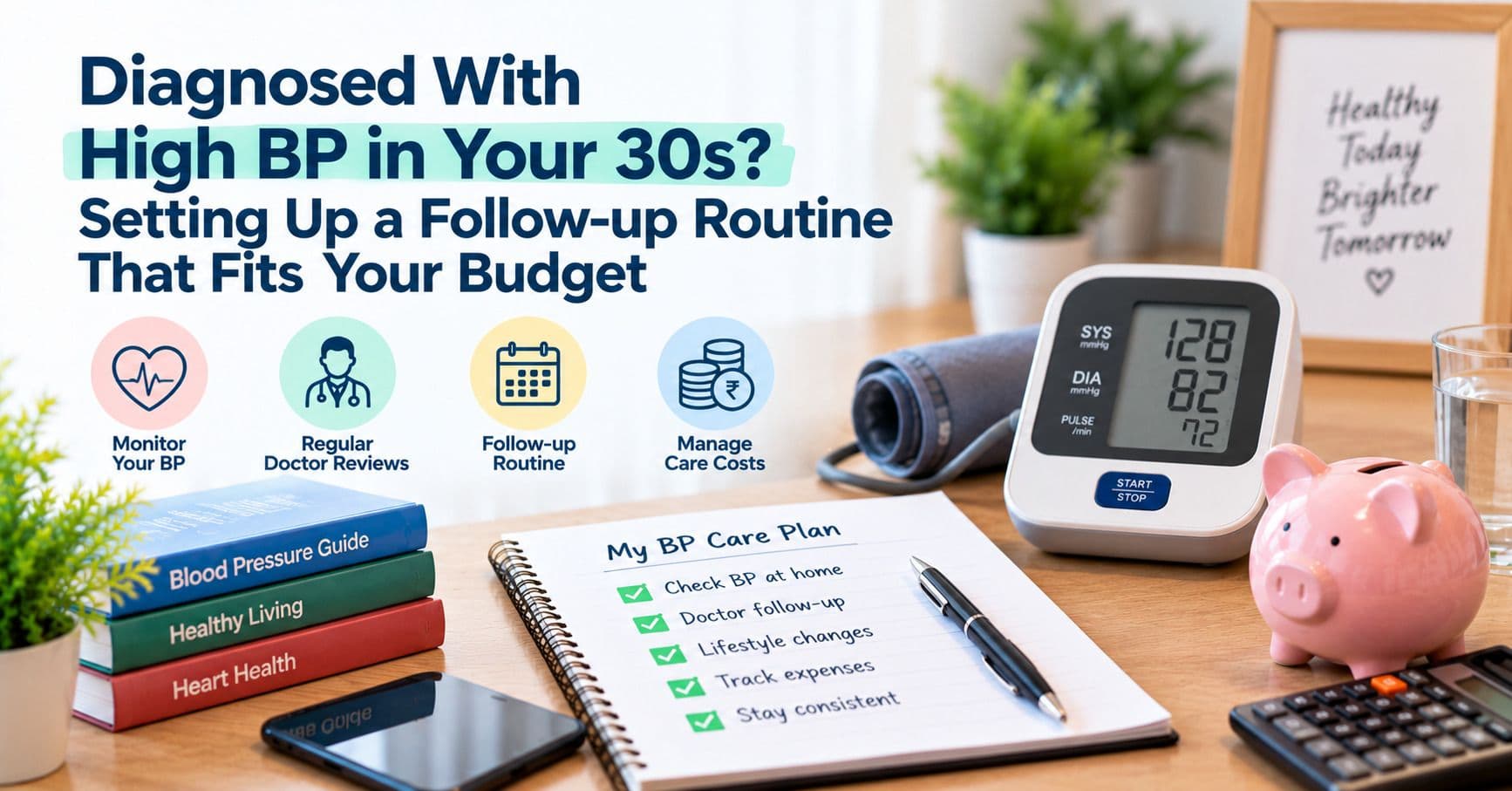
Diagnosed With High BP in Your 30s? Setting Up a Follow-up Routine That Fits Your Budget
21 OCT '2610 min
Meet Rohan. He is 34, works at an IT firm in Pune, and has not missed a Monday stand-up in three years. Everything seemed fine until last month, when a company health check flagged his blood pressure: 150/98. Suddenly the word "hypertension" is attached to his name. His first Google search was "what is high BP" and second was "kitna kharcha aayega?" (how much will this cost me?).
Rohan is a composite example. But if you have just heard the word "hypertension" in your thirties, his two questions are probably yours too. And you are in a very large company. WHO estimates 1.4 billion adults aged 30 to 79 had hypertension in 2024, and only about 23% had it under control. In India, the ICMR-INDIAB study estimated that 35.5% of adults, roughly 315 million people, live with high blood pressure.
Blood pressure is among the most controllable conditions in medicine. And controlling it does not need an expensive plan. It needs a steady, simple, affordable follow-up routine, which is exactly why you need to understand what is high BP and low BP, can it cause dizziness, and what causes your blood pressure to suddenly get high? Let’s answer your questions.
What Is High BP and Low BP?
Blood pressure is the force of blood pushing against your artery walls. It is written as two numbers: the top (systolic) number when your heart beats, and the bottom (diastolic) number when it rests between beats. Both are measured in mmHg.
The 2025 American Heart Association/American College of Cardiology (AHA/ACC) guideline groups readings like this:
| Category | Top number (systolic) | Bottom number (diastolic) |
|---|---|---|
| Normal | Below 120 | and below 80 |
| Elevated | 120 to 129 | and below 80 |
| Stage 1 hypertension | 130 to 139 | or 80 to 89 |
| Stage 2 hypertension | 140 or higher | or 90 or higher |
One thing to know is WHO describes hypertension as a reading of 140/90 mmHg or higher, while the US guideline starts at 130/80. So thresholds can differ between guidelines, and your doctor will decide based on repeated readings, never one stray number.
Low BP (hypotension) is generally a reading below 90/60 mmHg. It is usually a concern only when it causes symptoms such as lightheadedness, blurred vision, fainting or unusual tiredness. Many people with naturally low readings feel absolutely fine.
Why Does High BP Show Up in Your 30s?
Because life in your 30s often stacks the odds against you: long desk hours, irregular sleep, work stress, salty and processed food, less exercise, extra weight, smoking or alcohol. WHO lists a high-salt diet, physical inactivity and excess alcohol among the modifiable risks. Family history adds to the picture.
And the tricky part? Most people with hypertension feel nothing. WHO states that the only way to detect it is to have your blood pressure measured. That silence is why an estimated 44% of adults with hypertension do not even know they have it.
Can High BP Cause Dizziness?
Sometimes you may feel your BP is high, but not as often as people think. Mild to moderate high blood pressure usually causes no symptoms at all. Dizziness is more likely when readings climb very high, or when something else is going on. Common culprits include:
- Medicine effects. When treatment starts, your pressure may fall quickly and make you lightheaded, especially on standing up. Never stop or change the dose on your own; call your doctor instead.
- Low blood pressure. Dehydration, skipped meals or an over-effective dose can push readings below 90/60, and dizziness is a classic sign.
- Stress, anxiety or poor sleep, which can cause both dizziness and temporary BP spikes.
- A hypertensive crisis, where dizziness comes with severe headache, chest pain, vision changes or weakness (see below).
Exception: If dizziness comes with fainting, chest pain, slurred speech, facial droop or weakness on one side, call 112/108 right away, don't stop to measure first.
Do this: If you feel dizzy, sit down, sip water and check your BP using a validated upper-arm monitor. Note the reading and time in your log and share it with your doctor. Do not guess whether it is "high" or "low" without measuring.
What Causes Your Blood Pressure to Suddenly Get High?
A sudden jump does not always mean you have developed a new disease. Short-term triggers include:
- Emotional stress, anxiety, pain or a poor night of sleep
- A very salty meal, especially if you are salt-sensitive
- Too much caffeine, nicotine or alcohol
- Missed BP medicines, or certain pain relievers and decongestants
- The "white-coat effect", where nervousness at the clinic pushes numbers up
If spikes are frequent, or hypertension appears unusually early or is hard to control, doctors may look for secondary causes such as kidney, thyroid or adrenal conditions. The 2025 guideline expands recommendations on screening for secondary hypertension for this reason.
When It Is An Emergency
Reading of 180/120 mmHg or higher is called a hypertensive crisis. If it comes with chest pain, breathlessness, severe headache, vision changes, confusion or weakness, seek emergency care immediately. Do not wait for it to "settle".
Which Doctor to Consult for High BP? Build Your Care Team
You do not need to start with an expensive super-specialist. Start simple, and add people only when there is a reason.
- General physician or family doctor (start here). Confirms diagnosis, orders basic tests, starts treatment and handle ongoing follow-ups.
- Cardiologist. Helpful if you have chest pain, palpitations, breathlessness, a strong family history of early heart disease, or readings that stay high despite treatment.
- Nephrologist. Consider this if tests show kidney involvement, such as protein in the urine or raised creatinine.
- Endocrinologist. Useful when thyroid, adrenal or hormonal causes are suspected, which is more relevant when high BP strikes at a young age.
Your Budget-Friendly Follow-Up Routine
Research backs a “measure at home, review with your doctor” approach. In the TASMINH4 trial published in The Lancet, doctors who adjusted medicines using patients’ home readings achieved lower blood pressure after 12 months than routine clinic monitoring. Even the AHA/ACC guideline also stresses validated home monitoring.
That is great news for your wallet. Most of the work happens at home. Here is a routine you can adapt with your doctor:
| How often | What to do | Money-saving tip |
|---|---|---|
| Daily or weekly | Take readings at the same times, seated and rested, with your arm at heart level. Many protocols use two readings in the morning and two in the evening for several days. Record every value. | A one-time purchase of a validated upper-arm monitor replaces dozens of paid clinic visits. |
| Every 2 to 4 weeks (first 3 months) | Review your log with your doctor so doses can be adjusted early. | Use teleconsultation instead of travelling and taking time off work. |
| Every 3 to 6 months | Review of overall control, weight, habits and medicine side effects. | Ask for generic medicines (by salt name) and consider Pradhan Mantri Bhartiya Janaushadhi Kendras. |
| Once a year (or as advised) | Blood sugar, cholesterol, kidney function and urine tests, as your doctor recommends. | Bundle all tests into one rather than paying for them separately. |
Three rules that keep costs low and results high:
- Never skip doses to "save" medicine. Uncontrolled pressure is far costlier than a month of tablets, as complications like stroke, heart attack and kidney damage are what drive hospital bills.
- Bring your log, not just your memory. A two-week log can help your doctor decide in one short visit what might otherwise need three.
- Ask what can wait. Not every test is needed every visit. Your doctor can tell you which ones matter most for you.
Many government health centres also offer hypertension screening. Ask your nearest primary health centre what is available in your area.
Five Daily Habits That Helped Rohan
- Cut the salt. WHO recommends keeping salt intake below 5 grams (about one teaspoon) a day. Watch pickles, papad, namkeen and packaged snacks.
- Moved often. Brisk walking, cycling or yoga all count. Consistency beats intensity.
- Protected sleep. Poor and short sleep is linked with higher blood pressure.
- Limited alcohol and quit tobacco. Both are on WHO’s list of modifiable risks.
- Took medicines at a fixed time. Link it to brushing your teeth or morning tea so you never forget.
What Most Health Policies Don’t Cover: High BP Is an OPD Problem
Many people discover this late that a standard health insurance policy is built around hospitalisation. OPD (outpatient) costs, meaning regular doctor visits, tests and medicines, are usually not covered unless you add an OPD benefit. Hospitalisation policies often pay for some pre- and post-hospitalisation expenses, but only within a limited window.
And hypertension lives almost entirely in the OPD world. You are not in a hospital bed. You are in a clinic, a lab queue, or a chemist’s shop, month after month.
This is not a small matter. India’s National Health Accounts show that 43.4% of total health spending in 2022-23 was still out-of-pocket. An OPD plan can help cover many of these recurring costs. Get compliance sign-off
How We Help at Prime.care
We built Prime.care for exactly this stretch of the journey: the long, unglamorous middle after the diagnosis that includes regular readings and reviews to keep blood pressure controlled.
Rohan’s next step can be yours too. Do not wait for a dizzy spell or a scary number. Get yourself an OPD plan with a cashless wallet you can use to pay for consultations, tests, and medicines directly - easy on your pocket. Talk to a doctor from home with our unlimited teleconsultation services, share your BP log, and stay on track with habit coaching and wellness sessions. Start at Prime.care, or see how our OPD care options fit your situation.
Frequently Asked Questions
Is high BP in your 30s serious?
It can be, because years of uncontrolled pressure strain the heart, brain and kidneys. WHO notes that hypertension is a major cause of premature death worldwide. The upside is that being diagnosed early gives you decades to control it.
Can high blood pressure be reversed in your 30s?
Many people with elevated or stage 1 readings improve significantly with lifestyle changes, and some may not need lifelong medicine. Others need tablets alongside lifestyle changes, and that is perfectly fine. The AHA/ACC guideline supports a combination of lifestyle measures and, where needed, medication [3]. Do not stop any medicine without your doctor’s advice.
How often should I check my BP at home?
Your doctor will set the schedule, but a common approach is two readings in the morning and two in the evening for several days before a review, seated and rested [3]. Use a validated upper-arm monitor and write every reading down.
Do I need a cardiologist straight away?
Usually not. A general physician can confirm the diagnosis, start treatment and decide whether you need a specialist. A cardiologist becomes important if you have heart-related symptoms, a strong family history or hard-to-control readings.
When is high BP an emergency?
A reading of 180/120 mmHg or higher, especially with chest pain, severe headache, breathlessness, vision changes or weakness, needs emergency medical care [5].
Is hypertension treated as a pre-existing condition?
Insurers commonly treat an already-diagnosed condition as pre-existing and may apply waiting periods. Rules differ by insurer, so read the policy terms, disclose your diagnosis honestly, and ask the insurer in writing if unsure.


 Message us on WhatsApp